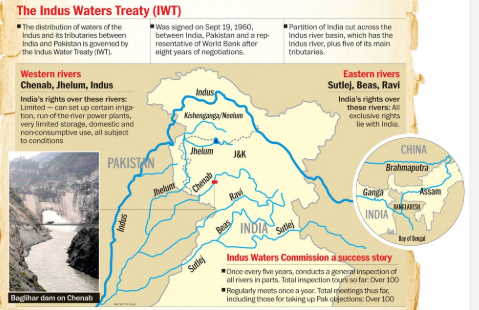
The Indus Waters Treaty (IWT) is a water-sharing agreement signed between India and Pakistan in 1960, with the World Bank as a mediator and guarantor. It is one of the most successful international water treaties in the world and governs the use of the Indus River System, which flows through both countries.
Introduction
The Indus Waters Treaty (IWT) is a bilateral water-distribution agreement signed between India and Pakistan on 19th September 1960 in Karachi. It was brokered by the World Bank (then known as the International Bank for Reconstruction and Development). The treaty governs the use of the waters of the Indus River System, a major transboundary river system that originates in Tibet and flows through both India and Pakistan. The nuclear-armed neighbors disagree over use of the water from rivers that flow downstream from India into the Indus river basin in Pakistan.
Indus Waters Treaty Issues
There have been issues concerning the treaty with both sides accusing each other of violating the terms of the treaty.
- In 2016, Pakistan had approached the World Bank raising concerns of India’s Kishenganga and Ratle hydroelectric power projects being constructed in Jammu & Kashmir. India then requested for neutral experts to inspect the plants, saying that the points raised by Pakistan were technical ones and do not require a court of arbitration (as Pakistan has taken it to an arbitration court). The World Bank permitted India to proceed with the projects after talks were concluded between both the countries on the technicalities of the treaty.
- The Tulbul project (which is a navigation lock-cum-control structure at the mouth of the Wular Lake, situated on the Jhelum from Anantnag to Srinagar and Baramulla) was suspended in 1987 after Pakistan objected to it. Recently, the government decided to review this suspension not taking into account Pakistan’s protests.
- Pakistan’s Left Bank Outfall Drain (LBOD) project passes through the Rann of Kutch in India’s Gujarat. The project was constructed without India’s consent. India has objected because this is in contravention to the IWT. The lower riparian state is in India and hence it needs to be given all details. There is also the danger of flooding in the state of Gujarat.
- Recently, the bilateral relations between India and Pakistan have taken on a downward spiral. In the wake of the Uri attacks on India, Prime Minister Modi remarked that blood and water cannot flow simultaneously indicating to Pakistan that its support to terrorism across the border will lead to India rethinking its generous stance on the IWT. Indeed, many experts believe that the treaty is more favourable towards Pakistan than India.
- Another issue cited with the IWT is that it was signed on India’s behalf by the then PM Nehru. However, he was not the head of state and that the treaty ought to have been signed by the head of state, the then president of the country.
- India does not use its entire share of water it is entitled to as per the provisions of the IWT. About 2 million acre-feet (MAF) of water from the River Ravi flows into Pakistan unutilized by India.
- In the wake of the Pulwama attacks in 2019, the Indian government stated that all water flowing into Pakistan at present, in the three eastern rivers, will be diverted to Haryana, Punjab, and Rajasthan for different uses.
- To prevent this flow and utilize the entire share of water under the Treaty, India has taken the following steps:
- Shahpurkandi Project: This will help in generating power for Punjab and Jammu & Kashmir.
- Ujh Multipurpose Project: This will create storage of water on the Ujh, which is a tributary of the River Ravi, for irrigation as well as power generation.
- 2nd Ravi Beas link below Ujh: This has been declared a National Project by the GOI. This involves constructing a barrage across river Ravi for diverting water through a tunnel link to the Beas Basin. This is planned to prevent excess water flowing into Pakistan.
Historical Context
-
After the Partition of India in 1947, the newly created nations of India and Pakistan inherited a shared river system.
-
The partition line (Radcliffe Line) did not take into account the flow of rivers; this created tension as Pakistan’s agricultural economy depended heavily on rivers originating in India.
-
In 1948, India stopped the flow of water briefly to Pakistan from the canals that passed through Indian territory. This led to the first Indo-Pak water dispute.
-
The World Bank intervened and proposed a permanent solution, resulting in 12 years of negotiations, which led to the Indus Waters Treaty of 1960.
Rivers Covered by the Treaty
The Indus River System includes six main rivers:
1. Western Rivers (allocated to Pakistan):
-
Indus
-
Jhelum
-
Chenab
2. Eastern Rivers (allocated to India):
-
Ravi
-
Beas
-
Sutlej
WHAT ARE THE CONCERNS OVER WATER?
Key Provisions of the Indus Waters Treaty
1. Division of Rivers
-
India received unrestricted use of the eastern rivers: Ravi, Beas, and Sutlej.
-
Pakistan received unrestricted use of the western rivers: Indus, Jhelum, and Chenab.
-
India is allowed limited non-consumptive use (for irrigation, power generation, navigation, etc.) of the western rivers.
2. Construction of Infrastructure
-
India helped finance the construction of canal systems and storage works in Pakistan to allow it to transfer water from western rivers and compensate for the loss of eastern rivers.
3. Permitted Indian Usage of Western Rivers
-
Run-of-the-river hydroelectric projects are allowed (without storage).
-
Limited agricultural use under strict guidelines.
-
No construction that may alter the natural flow significantly.
4. Dispute Resolution Mechanism
A three-tier process was established:
a) Permanent Indus Commission (PIC)
-
Composed of one commissioner from each country.
-
They meet at least once a year to discuss issues and inspect works.
b) Neutral Expert
-
In case of technical disputes that cannot be resolved by the PIC.
-
Appointed by mutual consent or the World Bank.
c) Court of Arbitration
-
For legal disputes regarding interpretation or violation.
-
Can include international judges and lawyers.
Legal Nature of the Treaty
-
The Indus Waters Treaty is binding under international law.
-
It does not have a termination or exit clause, making it perpetual unless both parties agree to change it.
-
The World Bank is a signatory and remains a guarantor for the implementation.
Importance of the Treaty
1. For Pakistan
-
Over 80% of Pakistan’s irrigation depends on the western rivers.
-
The treaty is vital for its food and water security.
-
Pakistan has been vigilant about Indian projects on western rivers.
2. For India
-
It provides exclusive control over eastern rivers.
-
It allows strategic usage of western rivers within limits.
-
India has not fully utilized its allocated share, prompting internal debate about maximizing usage.
Challenges and Criticisms
1. India’s Underutilization
-
India uses only around 20% of its entitlement under the treaty.
-
Projects are often delayed due to technical, environmental, and political reasons.
2. Pakistan’s Objections
-
Pakistan often raises objections against Indian hydroelectric projects (e.g., Baglihar, Kishanganga, Ratle).
-
Claims that India is violating the treaty by affecting river flow.
3. Security and Strategic Issues
-
After the Uri attack in 2016, India hinted at reviewing the treaty.
-
Prime Minister Narendra Modi said: “Blood and water can’t flow together.”
-
However, India did not withdraw but started speeding up hydropower projects on western rivers within legal bounds.
Important Hydroelectric Projects by India on Western Rivers
| Project | River | Status | Controversy |
|---|---|---|---|
| Baglihar | Chenab | Completed | Resolved by Neutral Expert |
| Kishanganga | Jhelum | Completed | Court of Arbitration ruled partially in favor of India |
| Ratle | Chenab | Under development | Ongoing objections by Pakistan |
Recent Developments
-
In 2023, India sent a notice to Pakistan through the World Bank seeking modification of the treaty, citing Pakistan’s repeated misuse of the dispute resolution mechanism.
-
India also demanded the review of the treaty to reflect current realities.
Indus Waters Treaty – Provisions in Brief
The treaty spells out conditions for water-sharing of the River Indus and its five tributaries.
- India got control over the three eastern rivers, which are:
- Ravi
- Beas
- Sutlej
- All the waters of the Eastern Rivers shall be available for the unrestricted use of India until the arise of any unwanted situation.
- Pakistan got control over the three western rivers, which are:
- Indus
- Chenab
- Jhelum
- A Permanent Indus Commission was set up by the United Nations for resolving any disputes that may arise in water sharing, with a mechanism for arbitration to resolve conflicts amicably.
- According to the treaty, India can use the water from the western rivers for domestic, non-consumptive needs such as storage, irrigation, and also the generation of electricity.
- The treaty gives India 20% of the water from the Indus River System and the rest 80% to Pakistan.
- In executing any scheme of flood protection or flood control each country(India/Pakistan) will avoid, as far as practicable, any material damage to the other country.
- The use of the natural channels of the Rivers for the discharge of flood or other excess waters shall be free and not subject to limitation by either India or Pakistan, and neither of the countries shall have any claim against the other in respect of any damage caused by such use.
Indus Waters Treaty Issues
There have been issues concerning the treaty with both sides accusing each other of violating the terms of the treaty.
- In 2016, Pakistan had approached the World Bank raising concerns of India’s Kishenganga and Ratle hydroelectric power projects being constructed in Jammu & Kashmir. India then requested for neutral experts to inspect the plants, saying that the points raised by Pakistan were technical ones and do not require a court of arbitration (as Pakistan has taken it to an arbitration court). The World Bank permitted India to proceed with the projects after talks were concluded between both the countries on the technicalities of the treaty.
- The Tulbul project (which is a navigation lock-cum-control structure at the mouth of the Wular Lake, situated on the Jhelum from Anantnag to Srinagar and Baramulla) was suspended in 1987 after Pakistan objected to it. Recently, the government decided to review this suspension not taking into account Pakistan’s protests.
- Pakistan’s Left Bank Outfall Drain (LBOD) project passes through the Rann of Kutch in India’s Gujarat. The project was constructed without India’s consent. India has objected because this is in contravention to the IWT. The lower riparian state is in India and hence it needs to be given all details. There is also the danger of flooding in the state of Gujarat.
- Recently, the bilateral relations between India and Pakistan have taken on a downward spiral. In the wake of the Uri attacks on India, Prime Minister Modi remarked that blood and water cannot flow simultaneously indicating to Pakistan that its support to terrorism across the border will lead to India rethinking its generous stance on the IWT. Indeed, many experts believe that the treaty is more favourable towards Pakistan than India.
- Another issue cited with the IWT is that it was signed on India’s behalf by the then PM Nehru. However, he was not the head of state and that the treaty ought to have been signed by the head of state, the then president of the country.
- India does not use its entire share of water it is entitled to as per the provisions of the IWT. About 2 million acre-feet (MAF) of water from the River Ravi flows into Pakistan unutilized by India.
- In the wake of the Pulwama attacks in 2019, the Indian government stated that all water flowing into Pakistan at present, in the three eastern rivers, will be diverted to Haryana, Punjab, and Rajasthan for different uses.
- To prevent this flow and utilize the entire share of water under the Treaty, India has taken the following steps:
- Shahpurkandi Project: This will help in generating power for Punjab and Jammu & Kashmir.
- Ujh Multipurpose Project: This will create storage of water on the Ujh, which is a tributary of the River Ravi, for irrigation as well as power generation.
- 2nd Ravi Beas link below Ujh: This has been declared a National Project by the GOI. This involves constructing a barrage across river Ravi for diverting water through a tunnel link to the Beas Basin. This is planned to prevent excess water flowing into Pakistan.
Options for India
A few political thinkers believe that the treaty is one-sided and biased towards Pakistan and that it should be abrogated.
However, this is easier said than done and not without serious ramifications.
- The treaty’s provisions do not allow a unilateral abrogation.
- Even if India decides to back down from the treaty, the 1969 Vienna Convention on the law of treaties should be abided by.
- This can hamper the country’s image internationally. India’s other neighbouring countries like Bangladesh and Nepal may become skeptical about similar treaties with them.
- Some experts on international affairs think that India should safeguard bilateral treaties if it is aspiring for a permanent seat in the UNSC.
- The move to abrogate the treaty may lead to more problems with respect to terrorist activities.
- India should also build adequate infrastructure to use the entire water before stopping water from Pakistan.
- Another angle is that of China. China, with its support to Pakistan, may block the water from the Brahmaputra to Assam. It can also stop the waters of the Indus which originates in the Chinese territory.
Experts opine that India should use the waters of the western rivers as permitted by the IWT. This alone can send a strong signal to Pakistan. A lot should be thought over before any other drastic steps are taken, as they can have lasting effects on the relationship with Pakistan.
Questions related to Indus Water Treaty
Conclusion – Indus Waters Treaty
The Indus Waters Treaty (1960) stands as a rare and enduring example of cooperation between two rival nations—India and Pakistan—despite ongoing political hostility, wars, and border conflicts. It has played a critical role in maintaining water-sharing stability in South Asia for over six decades. While the treaty has been remarkably resilient, recent disputes, climate change, growing populations, and increasing water demands have tested its limits.
For India, the treaty offers strategic and economic opportunities in the form of hydropower and irrigation, especially on the western rivers. For Pakistan, it remains a lifeline, as the Indus system forms the backbone of its agriculture and economy.
Moving forward, the success of the treaty will depend on mutual respect, trust, technical cooperation, and willingness to resolve disputes peacefully. In a time of increasing global water stress, the Indus Waters Treaty continues to serve as a model for sustainable and diplomatic transboundary water management.indus water treaty