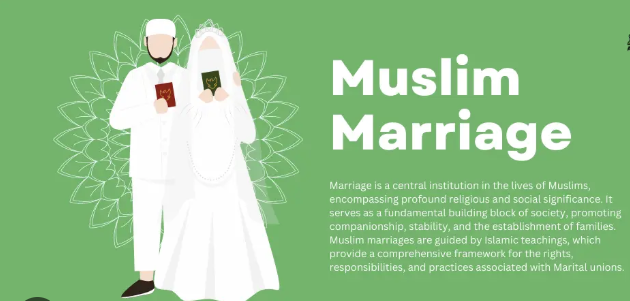
Introduction
Marriage, or Nikah, under Muslim law is not merely a religious or social institution but a civil contract with religious significance. Unlike Hindu law, where marriage is considered a sacrament, Muslim law views marriage as a legal agreement between two individuals, aimed at legalizing sexual relations, procreation, and the foundation of a family within the framework of Sharia.
In India, Muslim marriages are governed by personal law, primarily derived from the Quran, Hadith, Ijma, and Qiyas, along with statutory laws such as:
-
The Muslim Personal Law (Shariat) Application Act, 1937
-
The Dissolution of Muslim Marriages Act, 1939
-
Judicial precedents interpreting Sharia in light of the Indian Constitution
Legal Nature of Muslim Marriage
Under classical Islamic jurisprudence, marriage (Nikah) is:
-
A civil contract with mutual rights and obligations.
-
A sunnah (prophetic tradition) and highly recommended act.
-
Capable of being enforced by law.
The contract:
-
Requires mutual consent,
-
Is executed for lawful companionship, protection of morality,
-
and determines rights over mahr (dower), maintenance, and inheritance.
Thus, Nikah is contractual in form, but religious in spirit.
Essentials of a Valid Muslim Marriage (Nikah)
For a marriage to be valid under Muslim law, the following elements are mandatory:
1. Proposal and Acceptance (Ijab-o-Qubool):
-
Must be made and accepted at the same meeting.
-
Must be unconditional and mutually agreed.
2. Free Consent:
-
Consent must be free from coercion, fraud, or undue influence.
-
Marriage under duress is voidable.
3. Competency:
-
Both parties must be Muslim, of sound mind, and have attained puberty (assumed at 15 years in India).
-
However, under the Prohibition of Child Marriage Act, 2006, the legal age is 18 for girls and 21 for boys.
4. Mahr (Dower):
-
A mandatory obligation from the husband to the wife.
-
Can be prompt or deferred and is a symbol of respect and security for the wife.
5. Witnesses:
-
For Sunni Muslims: Minimum 2 male or 1 male + 2 female adult Muslim witnesses.
-
For Shia Muslims: Not mandatory but recommended
Types of Muslim marriages
There are four kinds of marriage in Muslim law.
There are four kinds of marriages as per Muslim law Sahih, Batil, Fasid and Muta. In essence, valid marriages must comply with certain conditions and rituals set forth by each muslim sect. An indvalid marriage, also known as illegal marriage under muslim law, is considered invalid primarily because certain legal obstacles exist. An illegal marriage that that is temporarily invalid and can be recognized as valid after a certain violations have been removed. Mutah marriage according to islamic law is a form of marriage that is concluded for a set period of time and it is recognized as per muslim law.
- Sahih marriage
- Batil marriage
- Fasid marriag.
- Muta marriage
Valid (Sahih) marriage:
Sahih marriage, also referred to as nikah, is the most commonplace form of marriage under muslim law. Its miles taken into consideration the handiest legitimate and lawful form of marriage, as it’s fars in accordance with the standard of Islam. In a sahih marriage, the parties enter right into a permanent and strong union, with the aim of living together as husband and spouse for the relaxation in their lives.
a valid marriage must adhere to the specific conditions and ceremonies outlined by the relevant Muslim sect. A void marriage, also known as a batil marriage under Muslim Law, is considered null and void primarily due to the presence of certain legal impediments.
An irregular marriage is a marriage that is temporarily invalid and may be deemed valid after the removal of some irregularities. Muta marriage under Islaminc Law is a type of marriage that is set for a predetermined duration and is recognized under Muslim Law
- There must have been proposal by one party and its acceptance by the other.
- Free consent of the parties.
- Proposal and acceptance must have taken place at one meeting and before two witnesses. They must be major and sound mind. And no witnesses are necessary under shia law.
- The parties must have capacity to contract marriage they should be sound of mind, major, capable to give free consent.
Legal Requirements of valid marriage.
- A proposal made by one party and accepted by the other.
- The marriage takes place in front of witnesses. Under Sunni law, the presence of two males or one male and two females who are sane, adult and Muslim is required. Under Shia law, the presence of witnesses is not essential at the time of marriage.
- The proposal and acceptance take place in the same meeting.
- The parties are capable of marrying, meaning they should be of sound mind and at the age of puberty. According to Hedaya, the age of puberty for girls is nine years and for boys is 12 years.
- The parties are capable of giving free consent. In the case of minors or lunatics, the consent of a guardian on their behalf is admissible.
- There should not be any legal disability, whether absolute (consanguinity, affinity, fosterage) or temporary (unlawful conjunction, polygamy, absence of proper witnesses, marriage with a woman undergoing iddat, different religions).
Consequences of valid marriage.
After fulfilling all of these conditions, the marriage becomes valid, meaning it gives rise to mutual duties and obligations that the husband and wife must follow during the course of their marriage. Sexual intercourse becomes lawful and children born out of a valid marriage are considered legitimate.
The parties become entitled to inherit each other’s property and the wife is entitled to dower and is obligated to observe iddat in case of dissolution of marriage or death of the husband.
Void (Batil) Marriage:
A void marriage, additionally referred to as a Bail Nikah, is a marriage that fails to satisfy the essential conditions for a valid marriage. In such a marriage, no felony rights or duties are known. The following styles of marriages are taken into consideration void.
- Marriages among events who’re closely associated by blood.
- Marriages that are prohibited by means of motive of affinity.
- Marriages with a foster mom or foster sister. Sunni law recognizes an exception for marriages with the foster mom of one’s sister or foster sister’s mom, foster son’s sister, or foster brother’s sister.
- Marriages with a woman who’s undergoing iddat (the duration of waiting after divorce or death of the husband) below Shia regulation.
- Marriages with a fifth wife.
- Marriages with someone else’s spouse, provided her marriage remains valid.
Consequences
The consequences of a void marriage are that it does not confer any legal obligations or rights on the parties involved. The wife is not entitled to dower or maintenance and any children born out of the marriage are considered illegitimate and have no right to inherit property. The parties are not required to follow legal divorce procedures and can simply separate and marry someone else without any legal formalities.
Irregular or invalid (Fasid) marriage:
Due to lack of some formality, or the existence of an obstacle which may be rectified, a marriage turns into irregular, however, this irregularity is not everlasting in nature and may be removed. as a result, the wedding itself isn’t illegal. it could be made valid once the prohibitions are rectified. Marriage in such occasions or with following prohibitions are called ‘Fasid’.
An irregular marriage, also known as a fasid marriage, is considered an invalid marriage because it does not fulfil all of the necessary conditions for a valid marriage.
However, this type of marriage in Islam can be converted into a valid marriage by removing the irregularities. The concept of irregular marriage is recognised only under Sunni law, as Shia law does not offer a middle path between valid and void marriages.
- A marriage shrunk without required wide variety of witnesses;
- A marriage with girls at some point of her Iddat duration;
- A wedding with girls without the consent of her dad or mum while such consent is needful;
- A wedding prohibited as a consequence of distinction of faith;
- A marriage with a woman who is pregnant, while the being pregnant changed into now not due to adultery or fornication;
- A marriage with a 5th wife.
If an irregular marriage has been consummated, the wife is entitled to dower and must undergo iddat under Islamic Law. The children born from such a marriage are legitimate. If the irregular marriage has not been consummated, the wife is not entitled to dower and the parties can separate without legal formalities.
Temporary (Muta) Marriage:
Muta marriage is a brief marriage agreement this is well-known in Shia Islam, even though it is not known through Sunni Muslims. This kind of marriage is a fixed-time period marriage contract that specifies the period of the wedding, that can range from some hours to numerous years. The wedding is robotically dissolved whilst the time period of the agreement is expires, without the need for a proper divorce.
The principle significance of muta marriage us that it affords a way for people to have interaction in a brief conjugal relationship without violating Islamic law. In condition wherein a everlasting marriage isn’t possible, along with while a person is visiting or when a women is in need of economic guide, a temporary marriage may be an answer.
Muta marriage is a temporary marriage contract that is prevalent in Shia Islam, although it is not recognised by Sunni Muslims. This kind of Muslim marriage is a fixed-term marriage contract that specifies the length of the marriage, which can range from a few hours to several years. The marriage is automatically dissolved when the term of the contract expires, without the need for a formal divorce.
The main significance of Muta marriage is that it provides a way for individuals to engage in a temporary marital relationship without violating Islamic law. In situations where a permanent marriage is not feasible, such as when a man is travelling or when a woman is in need of financial support, a temporary marriage can be a solution.
It is important to note that Muta marriage is not considered equivalent to permanent marriage and the rights and responsibilities of the parties to a Muta marriage are different from those in a permanent marriage.
Legal Requirements for a Valid Muta Marriage
For a Muta marriage to be valid under Muslim law, certain legal requirements must be met. These include:
Consent: Like all other forms of marriage under Muslim law, the parties to a Muta marriage must have the capacity to consent to the marriage. This means that they must be of sound mind, free from coercion and must have reached the age of puberty.
Offer and Acceptance: The marriage contract must be made through an offer and acceptance by the parties involved. The offer must be made by the man and the acceptance must be made by the woman.
Mahr: The man must pay a fixed amount of money or property to the woman as a gift or dowry. This is known as the Mahr and it is a mandatory requirement for all kinds of Muslim marriages.
Witnesses: Like in all other types of Muslim marriages, the Muta marriage must be witnessed by two male witnesses or one male and two female witnesses who are of sound mind and of Muslim faith.
Characteristics
There are some specific characteristics of Muta marriage that distinguish it from other forms of marriage under Muslim law. These include:
Fixed-term contract: The marriage is for a specified period, which is agreed upon by the parties involved.
No automatic right to inheritance: Unlike permanent marriages, the parties to a Muta marriage do not have an automatic right to inherit from each other.
No automatic custody of children: The mother does not have an automatic right to the custody of any children born out of the Muta marriage.
Criticisms and Controversies Surrounding Muta Marriage
Muta marriage is a controversial practice that has been criticised by some Muslim scholars and human rights groups. Some of the criticisms and controversies surrounding Muta marriage are:
Morality: Critics argue that temporary marriages violate the Islamic concept of morality and decency.
Exploitation: Some critics argue that Muta marriage can be a form of exploitation of vulnerable women, especially those in need of financial support.
Legal status: Muta marriage is not recognised by the Indian legal system, which means that women in Muta marriages may not have legal protection if they face abuse or violence.
Conclusion
There are four types of Muslim marriage that are recognised in Islamic law. Each of these types of marriage has its own unique characteristics and requirements and is subject to different rules and regulations under Islamic law. While some of these forms of marriage have been controversial and subject to criticism, they continue to be practised in various parts of the Muslim world.