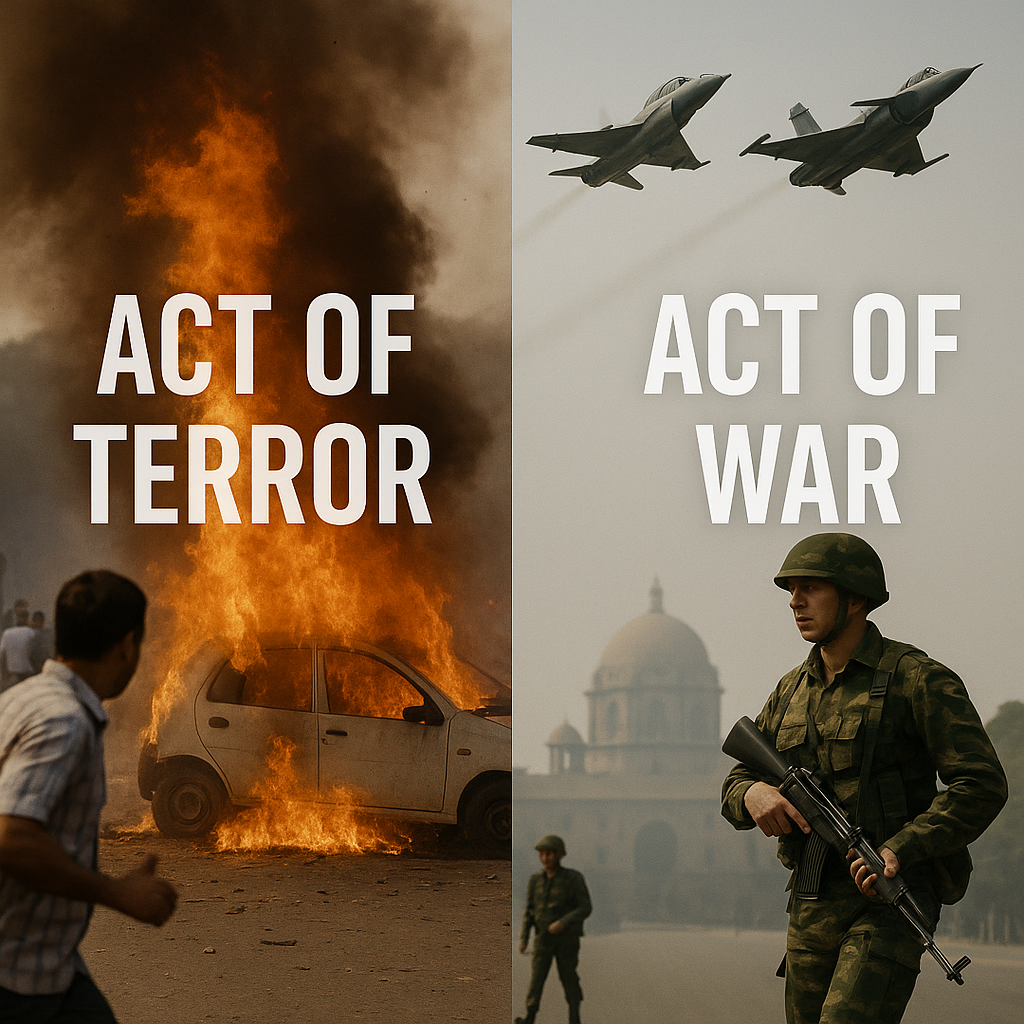
Terrorism has been a persistent security challenge for India, especially in the context of cross-border terrorism emanating from Pakistan. While most terrorist attacks are legally addressed under India’s anti-terrorism laws such as the Unlawful Activities (Prevention) Act (UAPA), certain high-impact attacks have been reclassified or politically portrayed as “acts of war” due to their scale, strategic implications, and foreign involvement. This article explores key instances where acts of terror in India have transitioned into the domain of war, both in rhetoric and military response.
In the evolving landscape of global and regional security, the distinction between terrorism and conventional warfare is increasingly blurred. Traditionally, acts of terrorism are viewed as internal security threats, prosecuted under criminal and anti-terror laws. However, in certain exceptional cases, the scale, intent, and international dimensions of terrorist attacks compel states to respond with military force, framing such attacks as acts of war rather than isolated criminal acts. India, a nation that has faced sustained cross-border terrorism for decades—particularly from state-sponsored groups operating from Pakistan—offers significant examples of this transformation. In key incidents such as the 2001 Indian Parliament attack, the 2016 Uri attack, and the 2019 Pulwama bombing, and the 2025 Pehalgam terror attack the Indian government and military not only identified the perpetrators as non-state actors but also pointed to state complicity, justifying responses that resembled war-time measures. This article explores how certain terror attacks in India have been politically and strategically reframed as acts of war, and what this reclassification means in legal, diplomatic, and military terms.
New Delhi, May 10, 2025 (ANI): India has decided that any future act of terror will be considered an “act of war” against India and will be responded to accordingly, the top government sources said on Saturday.
Earlier in the day, amid the escalating tensions between India and Pakistan, Prime Minister Narendra Modi chaired a meeting with Union Defence Minister Rajnath Singh, National Security Advisor Ajit Doval, Chief of Defence Staff (CDS) and chiefs of the Indian Armed Forces at his residence in New Delhi.
The meeting took place following India’s strikes at four airbases in Pakistan in the early hours of Saturday in reply to Pakistan’s attack on 26 Indian locations.
Indian Army Colonel Sofiya Qureshi stated that precision strikes were carried out on Pakistani military targets in Rafiqui, Murid, Chaklala, Rahim Yar Khan, Sukkur, and Chunian, as well as radar sites at Pasrur and Sialkot aviation bases, using air-launched weapons from Indian fighter aircraft.
Earlier today, Foreign Secretary Vikram Misri, Colonel Sophia Qureshi and Wing Commander Vyomika Singh briefed the media about the ongoing developments amidst the rising tensions between India and Pakistan.
Vikram Misri emphasised that the actions being undertaken by Pakistan against India are being seen as “escalatory” and “provocative” in nature.
He made the remarks during a press briefing on Saturday, where proofs of Pakistan’s escalatory and provocative actions were provided alongside exposing the lies being peddled by Pakistan.
While speaking to the media, the Foreign Secretary said, “Pakistan’s actions constituted provocation, escalation. In response, India defended and reacted in a responsible and measured fashion”.
Despite the intensity of the attacks, Indian forces successfully engaged and retaliated, though airbases in Udhampur, Pathankot, Adampur, Bhuj, and Bathinda sustained damage, and personnel were injured.
Pakistan’s use of high-speed missiles at 1:40 AM to target Punjab’s airbase station and the unprofessional targeting of hospitals and schools in airbases in Srinagar, Awantipora, and Udhampur were particularly condemned.
India categorically rejected Pakistan’s malicious misinformation campaign, which falsely claimed the destruction of critical Indian military assets and infrastructure.
Wing Commander Vyomika Singh, while addressing the joint press conference, highlighted Pakistan’s attempts to spread disinformation about damage caused to the S-400 system at Adhampur, airfields at Suratgarh and Sirsa, Brahmos space at Nagrota, and artillery-gun positions in Dehrangyari and Chandigarh, among other allegations.
She emphasised that India unequivocally rejects these false narratives, which are part of a broader strategy to undermine India’s military capabilities and instil fear among the public.
The incidents of heavy shelling and cross-border firing were reported from various places aligning with Pakistan border on Saturday.
This decision comes in the wake of Pakistan’s repeated attempts to target Indian civilian centers using drones and missiles. On May 8 and 9, Pakistan launched a sustained drone offensive, deploying an estimated 1,000 drones in an apparent bid to overwhelm India’s air defense systems and strike towns and cities near the border and the Line of Control (LoC). Simultaneously, the Pakistan Army has intensified mortar shelling across multiple sectors along the LoC in Jammu and Kashmir, inflicting significant damage to civilian life and property and resulting in tragic loss of lives.
Conclusion
The reclassification of certain terrorist attacks in India as acts of war marks a significant shift in both policy and perception. It reflects the reality that in the modern era, non-state actors often function as proxies for state interests, blurring the lines between terrorism and conventional warfare. India’s responses to incidents like the 2001 Parliament attack, the 2016 Uri attack, and the 2019 Pulwama bombing demonstrate and a 2025 Pehalgam attack a deliberate move toward a more assertive national security doctrine, where military retaliation and strategic deterrence play a central role. While these responses stop short of formal war declarations, they send a clear message: large-scale terrorism, especially when state-sponsored, will not be treated merely as a law-and-order issue but as a matter of national sovereignty and defense. This evolving approach raises important questions about the legal framework of conflict, the role of international law, and the future of state responses to asymmetric warfare. As threats continue to evolve, so too must the definitions and doctrines that guide national and international responses.